

✦
Where Artistry Begins
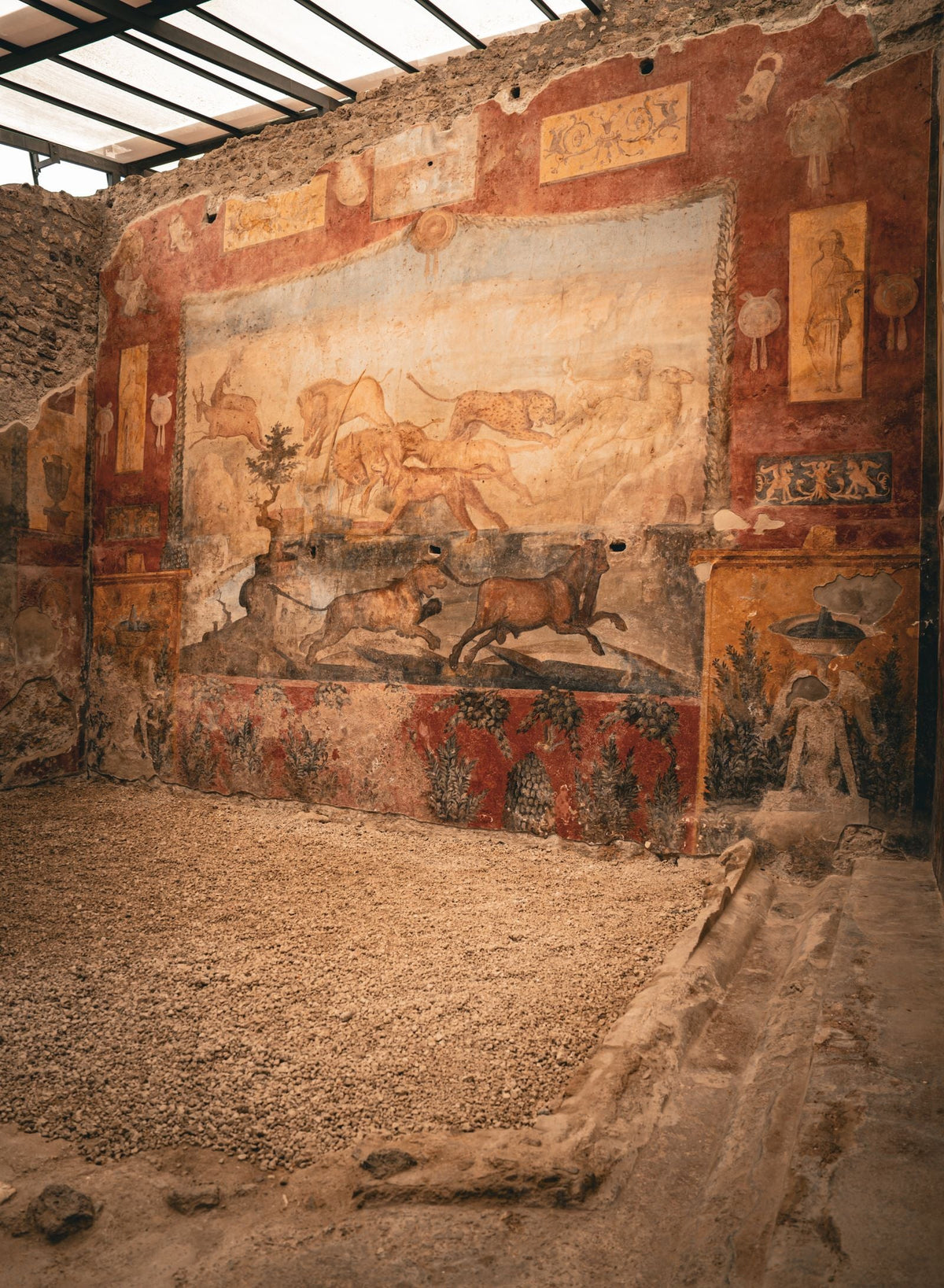
Trompe l'oeil is painting that sets out to fool the eye. The name is French and means, quite literally, deceive the eye. It describes any picture painted so convincingly that for a moment you believe the object or the space in front of you is real. A window where there is only plaster, an open sky where there is a ceiling, a stone niche on a perfectly flat wall. Most trompe l'oeil is painted as a mural, directly onto a wall or ceiling, and it is still one of the most theatrical things you can do with a room.
Below we look at where the idea comes from, a few of the most famous examples, how the illusion actually works, and how the same thinking can be used in homes, hotels and restaurants today.
Britannica defines trompe l'oeil as the representation of an object with such verisimilitude that it deceives the viewer about its material reality. In plain words, it is not just realistic painting. A realistic portrait is still obviously a picture in a frame. Trompe l'oeil tries to make you forget the picture is there at all.
The ambition is very old. The ancient Greek painter Zeuxis was said to have painted grapes so real that birds flew down to peck at them. Whether or not that story is true, painters have been chasing the same effect ever since, and walls and ceilings have always been their favourite place to do it.
Some of the earliest surviving trompe l'oeil is on the walls of Roman houses buried at Pompeii and nearby. From around 80 BC a style of decoration now called the Second Style became fashionable. Instead of treating the wall as a flat surface, painters filled it with columns, colonnades, balconies and distant buildings, so that the room seemed to open out like a window onto a view. A bedroom from a villa at Boscoreale, near Pompeii, now reconstructed at the Metropolitan Museum of Art in New York, uses several vanishing points so that the painted architecture appears to recede in different directions around the room.

In the Ducal Palace in Mantua, Andrea Mantegna painted the room known as the Camera degli Sposi, or Camera Picta, between 1465 and 1474 for Ludovico Gonzaga, Marquis of Mantua. At the centre of the ceiling is a painted oculus, a round opening to the sky. Servants and winged children peer down at you from its rim, and a pot plant balanced on a pole looks as though it might fall on your head. The figures are sharply foreshortened, painted as they would appear seen from directly below, a technique known in Italian as di sotto in sù.
The church of Sant'Ignazio in Rome was meant to have a dome, but the money ran out before it could be built. In 1685 the painter Andrea Pozzo solved the problem with a dome painted on a flat round canvas, around sixteen metres across. Between 1691 and 1694 he went on to paint the vast nave ceiling, the Glorification of Saint Ignatius, where painted architecture carries on from the real stonework so smoothly that it is very hard to see where one stops and the other begins. A marker set into the church floor shows visitors where to stand for the illusion to work perfectly.

Good trompe l'oeil is less about painting detail and more about controlling how the eye reads a surface. A few principles do most of the work.
You do not need a palace to use these ideas. A trompe l'oeil mural works especially well where a room is missing something.

Hospitality spaces often have exactly the problems painted illusion was invented to solve. Private dining rooms without windows, long hotel corridors, lift lobbies and basement bars can all be given a view, a sense of height or a touch of wit. Because the painting is made for one wall, it can be planned around the way guests actually move through the space, so the best view lands where people sit or pause. In busy areas a mural can also be sealed so it copes with daily wear.
Zavoré paints murals by hand, on site, directly onto the wall. That includes florals, landscapes, scenes and chinoiserie, painted onto the wall itself or onto gold leaf, silver leaf or grasscloth backgrounds. If you have a trompe l'oeil idea in mind, whether a painted sky, a view or an architectural detail, we are happy to talk it through with you and see how it could work in your room. Painted work can also sit beautifully alongside real plaster cornice and panel mouldings, which help frame the illusion.
Not quite. A mural is any painting made directly on a wall or ceiling. Trompe l'oeil is a particular approach in which the painting tries to look like real objects or real space. Many trompe l'oeil works are murals, but most murals are not trompe l'oeil.
Often it works best there. A painted window or view can make a small, enclosed room feel more open, and the close viewing distance means the details are appreciated.
The effect is always strongest from one viewpoint. A good design picks the position you will see it from most, such as the doorway or the sofa, and still looks attractive from elsewhere.
Yes, with the right protection. Murals in busy areas can be sealed after painting to help them resist marks and cleaning.
Where to go next. See our hand painted murals to find out how we work, or read our guide to hand painted chinoiserie. For more ways to make one wall the star of a room, browse our feature walls and plaster cornice and mouldings. When you are ready to talk about an idea, get in touch or call or WhatsApp 07592 929191.
How to read the period of a cornice in a Georgian, Victorian or Edwardian house, what separates cornice from coving, and how damaged runs...
Buying GuideWhat a ceiling rose is and where it came from, how to size one to the room and the light, which styles suit which period, how to fit one ...
BathroomsIdeas for mosaic splashbacks in kitchens, bathrooms and bars, the materials that cope near heat and water, and a step by step method for ...
BathroomsGlass, marble and stone mosaic each behave differently in a wet room. This guide covers which to choose for showers and floors, grout, co...
CorniceA practical, step by step method for fitting plaster coving, from guide lines and mitres to adhesive, filling and painting, with a clear ...
Buying GuideAn honest look at off the shelf fluted wall panels against seamless sculptural plaster, the difference between fluted and reeded, and whe...

Authentic Venetian plaster, machine-tinted to your colour and made for each order. Materials, installation and master-led training, nationwide and international, since 2021.
One list, run by the people who make the material. No noise, and nothing we would not want to read ourselves.
We email as the house has something worth saying, never daily. Unsubscribe from any email, or reply STOP to any text. We never pass your details to anyone.