

✦
Where Artistry Begins
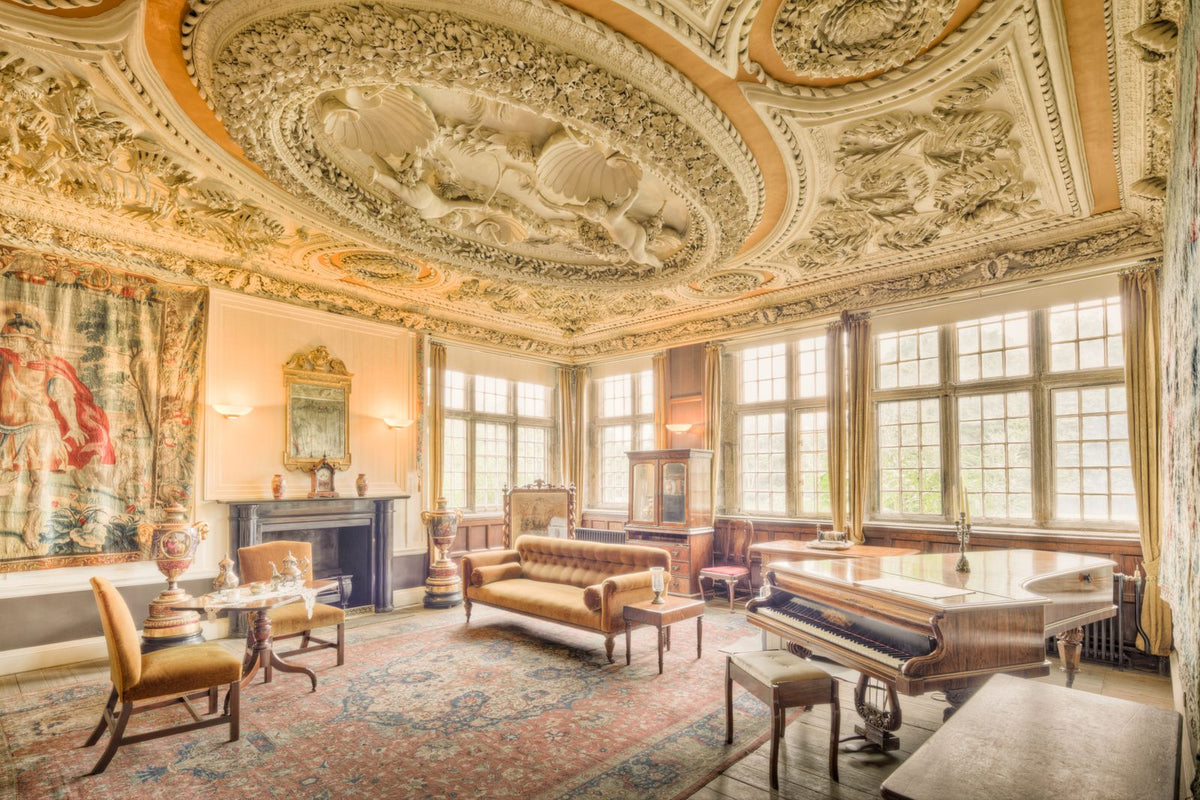
Victorian, Georgian and Edwardian coving all do the same job, closing the joint where the wall meets the ceiling, but each period tends to have its own look. As a rough guide, Georgian cornice leans towards ordered classical ornament, Victorian cornice is often deeper and richer in the main rooms, and Edwardian work is frequently lighter and paired with a picture rail. Those are tendencies, not rules. The most reliable guide to what belongs in your room is the house itself and the houses around it.
This guide covers how to read the period of a cornice, the difference between cornice and coving, how damaged runs are repaired and matched, and why we work in plaster. If you already know what you need, our plaster cornice and coving page explains what we supply, fit, restore and match.

In everyday British use the two words overlap, and the Victorian Society's own advice on interior mouldings uses them side by side. Where people do draw a line, coving usually means a plain, curved profile, and cornice means a moulding built up from steps, beads and ornament. The word cornice comes from classical architecture, where Britannica describes it as the top member of the entablature, the projecting band that crowns a building. Indoors, the same idea crowns a room.
So the honest answer to cornice vs coving is that a plain curved cove is coving, a richer stepped profile is cornice, and plenty of people call both by either name. What matters more is whether the profile suits the room and the age of the house.
Every guide to period features simplifies, and this one does too. Treat what follows as clues to weigh, not a test to pass.
The Georgian period is usually dated from 1714 to 1830. Its interiors drew heavily on classical sources, and from the 1760s Robert Adam's light, small scale ornament, which the V&A describes as distilled from ancient and Renaissance sources, spread well beyond the great houses. Conservation writers note that lime plaster predominated until the late eighteenth century, when cast enrichments made it possible to produce repetitive low relief ornament far more quickly. In practice a Georgian cornice often reads as ordered and architectural, with crisp classical motifs such as egg and dart or Greek key.
Victorian houses, built in the reign of Queen Victoria from 1837 to 1901, are where most searches for Victorian coving begin. From the middle of the nineteenth century, fibrous plaster, which Historic England describes as plaster of Paris reinforced with hessian and secured in a timber framework, made large and elaborate mouldings cheaper to produce off site. The result in many homes is a deeper, busier Victorian cornice in the hall and front reception rooms.
The Victorian Society points out that bedrooms, attics and service rooms were usually given the minimum of decoration, so a plain cove upstairs does not necessarily mean something has been lost.

The Edwardian years are short, from 1901 to 1910, and the change from late Victorian work was gradual. Picture rails carried on through the period, often with a frieze between the picture rail and the cornice, a fashion that began in the later Victorian years. Edwardian coving is often described as lighter and simpler than mid Victorian work, but you can find heavy Edwardian cornice and plain Victorian cornice in the same street, so use this as a hint rather than proof.
The Victorian Society suggests looking for bumps and old fixing marks under a raking light, comparing your house with neighbouring houses of a similar age and style, and visiting preserved interiors that are open to the public. A surviving run in a neighbour's front room will usually tell you more than any style guide.
Period cornice is often cracked, broken at the corners, missing where a wall was moved, or so clogged with paint that the detail has gone soft. Conservation guidance is consistent here. Repair rather than replace wherever you can. Irish government guidance on decorative plasterwork calls this minimum intervention, and notes how often fine detail is obliterated under layers of paint.
If your house is listed, speak to your local authority before you start. Local planning guidance on listed interiors is clear that cornices and roses of historic interest should be kept, and that repair means exact like for like replication, not new work with a passing resemblance.
When a room is extended, knocked through or partly replastered, the new cornice has to meet the old one without a visible change. There are two traditional routes. A cornice can be run in place with a running mould, a metal profile cut to the exact section and drawn along the wet plaster, or it can be made on the bench and fixed afterwards. Either way the starting point is an accurate record of the existing profile, usually a tracing of a clean section or a mould taken from it.
Enrichments such as egg and dart or leaf bands are cast separately and set into the run so they line up with the originals. Done properly, you cannot see where the old work stops and the new begins.

Polystyrene and foam coving is light, cheap and quick to fit, and over a plain modern room it can pass. In a period room the difference shows. Foam detail is softer, it does not take paint in the same way, and it cannot be repaired or blended into an old run the way plaster can. Plaster holds a crisp edge, sits naturally with the plaster ceiling it meets, and can be patched, cleaned back and repainted for generations. In a period house it is also what the original was made from.
Look at the corners, the joints and the depth of the detail. Original runs often show slight irregularities, years of paint build up, and a profile shared with neighbouring houses of the same age. A run that looks too perfect, shows regular visible joints, or sounds hollow and light when tapped may be a later replacement.
Yes, as long as enough survives to take an accurate profile. We make new lengths to match an existing profile and blend the repair into the old run.
Small cracks and short gaps in plain coving are within reach of a careful DIYer, and our guide on how to fit plaster coving covers fixing, joints and filling. Ornate period cornice, loose sections over your head and anything in a listed building are jobs for a specialist.
It should belong to the same family, close in period and in weight of detail, but it does not need to repeat the same motifs. Our guide to choosing a plaster ceiling rose covers sizing and style.
Where to go next. See what we supply, fit, restore and match on our plaster cornice and coving page, or send photos of your existing cornice and the room sizes through our contact page and we will tell you what we think is there and how we would approach it.
What a ceiling rose is and where it came from, how to size one to the room and the light, which styles suit which period, how to fit one ...
BathroomsIdeas for mosaic splashbacks in kitchens, bathrooms and bars, the materials that cope near heat and water, and a step by step method for ...
BathroomsGlass, marble and stone mosaic each behave differently in a wet room. This guide covers which to choose for showers and floors, grout, co...
CorniceA practical, step by step method for fitting plaster coving, from guide lines and mitres to adhesive, filling and painting, with a clear ...
Buying GuideAn honest look at off the shelf fluted wall panels against seamless sculptural plaster, the difference between fluted and reeded, and whe...
Feature WallsFeature wall ideas room by room, using Venetian plaster, limewash, murals, sculptural plaster, mosaic and more, with advice on choosing t...

Authentic Venetian plaster, machine-tinted to your colour and made for each order. Materials, installation and master-led training, nationwide and international, since 2021.
One list, run by the people who make the material. No noise, and nothing we would not want to read ourselves.
We email as the house has something worth saying, never daily. Unsubscribe from any email, or reply STOP to any text. We never pass your details to anyone.