

✦
Where Artistry Begins
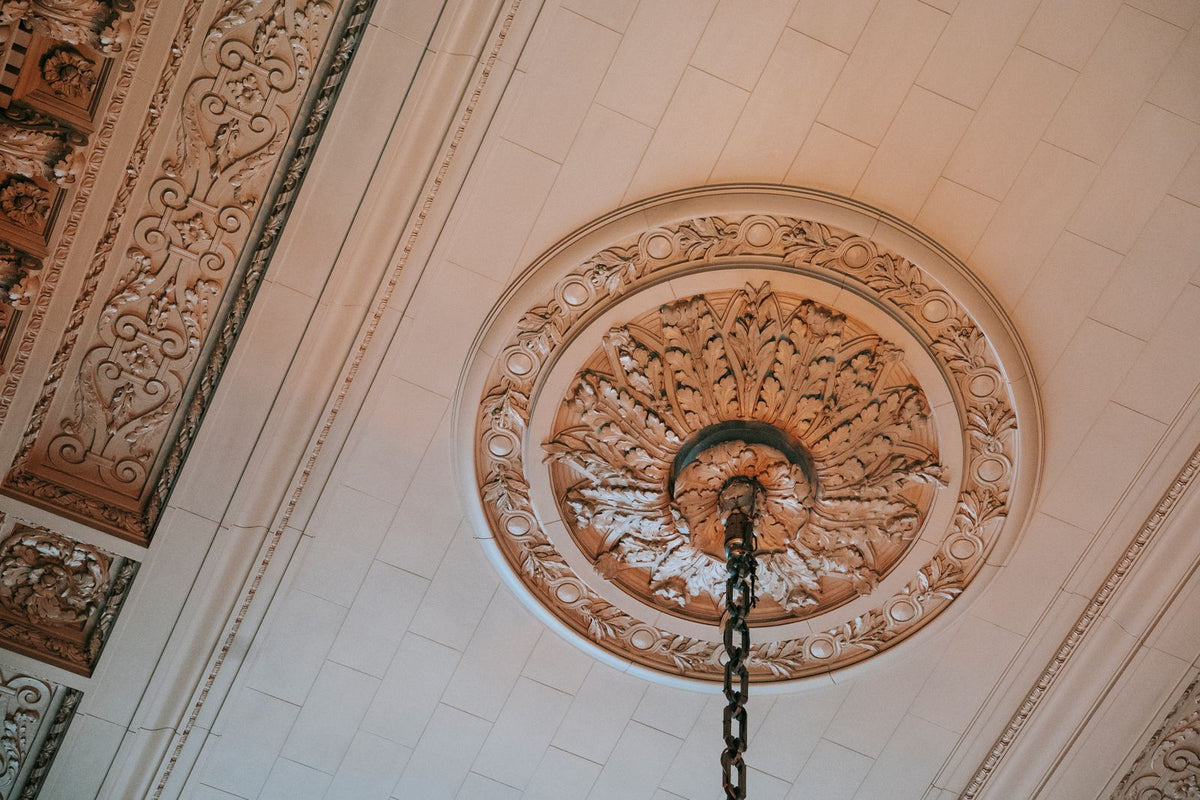
To choose a plaster ceiling rose, start with the room rather than the catalogue. Pick a rose in proportion to the ceiling and to the light that will hang from it, in a style that belongs with the cornice and the age of the house, and agree with your electrician how the light will be wired and supported before anything goes up. A ceiling rose is the round ornamental moulding at the centre of a ceiling, where the light hangs. Chosen well, it looks as if it has always been there.
This guide covers what a ceiling rose is and where it came from, sizing, period styles, fitting safely around electrics, pairing a rose with cornice and panel moulding, and what fibrous plaster is. You can see the roses and mouldings we supply and fit on our plaster cornice and coving page.

A ceiling rose is a moulding, usually plaster, fixed flush to the ceiling with a central point for a light or chandelier. That centre is usually where the cable for the main light comes through the ceiling. Confusingly, the same name is used for the small round electrical fitting a pendant hangs from. The Science Museum holds a turned wooden electrical ceiling rose dated 1880.
Central ceiling ornaments were part of British interiors long before electric light. The V&A notes that in the eighteenth and nineteenth centuries it was common to use ceiling papers printed to imitate moulded plaster or papier mâché, both more expensive ways to decorate a ceiling. One example in its collection, dated 1850 to 1875, is a printed rosette for the centre of a ceiling, its design made by bending an acanthus moulding into a circle.
Not every room had one. The Victorian Society points out that bedrooms, attics, servants' quarters and domestic offices were usually given the minimum of decoration. You will also read that roses were there to hide soot from gas lamps. We have not found a reliable source that confirms this, so we treat it as a likely story rather than settled history.
There is no official formula for ceiling rose size, and we would be wary of any rule that claims to be one. These are the checks we use.
On position, the Victorian Society advises that when reinstating a rose you align it with the centre of the chimney breast, which may not be the geometric centre of the ceiling.

As with cornice, these are tendencies rather than rules.
Our guide to Victorian, Georgian and Edwardian coving goes further into reading the period of a room.
A ceiling rose goes exactly where the light cable comes through the ceiling, so the electrics have to be planned in.

A ceiling rose rarely works on its own. It should belong to the same family as the cornice, close in period and weight of detail, without repeating every motif. A deep, rich cornice with a tiny plain rose looks unfinished, and the reverse looks top heavy.
Panel moulding carries the same language down the walls, turning plain plaster into a panelled room. Plaster corbels add another layer. Britannica defines a corbel as a bracket or weight carrying member built into a wall. In a plastered interior a corbel is usually decorative, set under an arch or a beam. We supply ceiling roses, cornice, panel mouldings and plaster corbels supply only, or supply and fit them, so a scheme can be drawn together.
Historic England describes fibrous plaster as plaster of Paris reinforced with layers of hessian and secured within a timber framework. It was used to imitate more expensive, traditional lime based, hand modelled plasterwork, and it was fitted in a wide range of Victorian and Edwardian buildings, theatres and music halls among them. A French modeller, Leonard Desachy, patented a method for making mouldings in this way in 1856 and set up in London soon after.
Because it is cast in a workshop and is lighter than solid plaster, fibrous plaster made rich ornament far more affordable. Historic England also notes that old fibrous plaster ceilings can present a risk of collapse if neglected, so if an old ceiling or a heavy old rose shows cracks or movement, have it looked at.

For a period room, plaster. It holds crisper detail, takes paint properly and can be repaired. Polystyrene is lighter and cheaper, but the difference shows, especially close to a plaster cornice.
A light rose can be a reasonable DIY job, but the electrical side should be left to a qualified electrician, and heavy roses need a secure mechanical fixing.
Yes, if the design is simple. A plain ring or stepped rose gives a modern ceiling a centre without making it feel like a period piece.
Yes. Ceiling roses, cornice, coving, panel mouldings and corbels are available supply only, or supplied and fitted by us. If you are fitting coving at the same time, our guide on how to fit plaster coving will help.
Where to go next. Browse what we make and fit on our plaster cornice and coving page, or send a photo of the room, the ceiling height and the light you plan to use through our contact page, and we will suggest roses that suit.
Ideas for mosaic splashbacks in kitchens, bathrooms and bars, the materials that cope near heat and water, and a step by step method for ...
BathroomsGlass, marble and stone mosaic each behave differently in a wet room. This guide covers which to choose for showers and floors, grout, co...
CorniceA practical, step by step method for fitting plaster coving, from guide lines and mitres to adhesive, filling and painting, with a clear ...
Buying GuideAn honest look at off the shelf fluted wall panels against seamless sculptural plaster, the difference between fluted and reeded, and whe...
Feature WallsFeature wall ideas room by room, using Venetian plaster, limewash, murals, sculptural plaster, mosaic and more, with advice on choosing t...
Feature WallsWhat chinoiserie is, how Chinese painted wallpaper arrived in British country houses, and how printed rolls, hand painted panels and a mu...

Authentic Venetian plaster, machine-tinted to your colour and made for each order. Materials, installation and master-led training, nationwide and international, since 2021.
One list, run by the people who make the material. No noise, and nothing we would not want to read ourselves.
We email as the house has something worth saying, never daily. Unsubscribe from any email, or reply STOP to any text. We never pass your details to anyone.