

✦
Where Artistry Begins
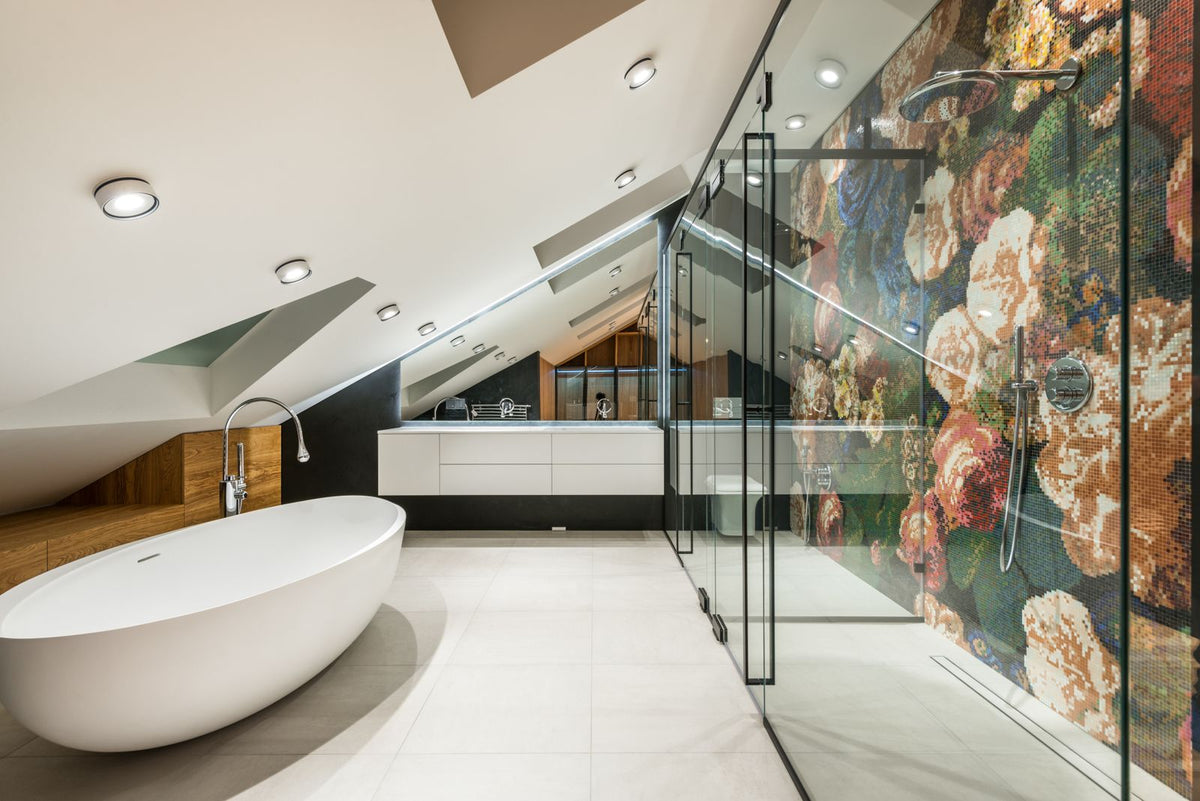
The best mosaic bathroom tiles are the ones whose material suits how wet each surface gets. Glass mosaic does not absorb water, so it is the easiest choice for showers and splash zones. Marble mosaic brings softer colour and a natural feel, but it is porous and needs sealing and gentle cleaning. Stone and porcelain sit between the two. Pick the material first, then the size, colour and grout, and the bathroom will look good for years rather than months.

Each material behaves differently once water and soap are involved, so it helps to know what you are choosing.
Whatever you choose, the tile is only one layer. In a shower, the wall or floor behind the mosaic is normally waterproofed first, and the adhesive and grout should be products made for wet areas.

Mosaic is a favourite for shower trays and walk in showers for a good reason. Small tiles can follow the fall towards the drain far more easily than large format tiles, which would have to be cut or would sit unevenly. The many grout joints also give your feet more to grip than one wide, smooth surface, and wider joints add a little more grip again.
The trade off is cleaning. More grout lines mean more places for soap, body oil and hard water marks to collect. That is why grout choice matters so much in a mosaic bathroom.
Where the floor meets the wall, and at internal corners, a flexible silicone sealant goes in rather than grout, so the joint can move without cracking.
Mosaic gives you more control over colour than almost any other wall finish, because every small piece can be a different shade. A few ways to use that well.

Most mosaic is sold as ready made sheets, with the small pieces held on a mesh backing or a paper face. Sheets are quicker to fix, give an even pattern and are the sensible choice for large areas of plain colour or a repeating design.
A bespoke mosaic is designed for one wall or floor. It can be a pattern drawn to fit the room, a picture, or a logo or monogram, and it is laid to suit the exact size of the space so borders and centre lines fall where they should. Many people combine the two, with ready made sheets on most of the room and one bespoke panel where it will be seen. Zavoré supplies ready made mosaics, designs bespoke mosaic, and installs both, including mosaic you have bought elsewhere. You can see the options on our mosaics page.

Good mosaic depends on what you cannot see. The basics a fixer will work through are these.
If you are weighing up mosaic against a seamless finish, our guides to tadelakt bathrooms and microcement in bathrooms cover the alternatives, and many bathrooms use both.
It can be, as long as you accept the care it needs. Marble must be sealed and resealed, cleaned with pH neutral products, and kept away from acidic cleaners and descalers. If you want something closer to no maintenance, glass or porcelain mosaic with epoxy grout is easier.
Mosaic is usually less slippery than large polished tiles because the grout joints give grip. A honed or textured finish helps further, while highly polished stone is best kept to walls.
The glass itself does not absorb water and does not need sealing. A cement based grout between the pieces usually does, which is one reason many people choose epoxy grout with glass.
Yes. Zavoré installs mosaics bought elsewhere as well as the ranges we supply, and can advise on adhesive and grout for the material you have chosen.
Where to go next. Browse ready made and bespoke options on our mosaics page, read our guide to mosaic splashbacks and grouting, or see how plaster finishes work in wet rooms in our Venetian plaster bathroom guide. When you are ready to talk about your bathroom, get in touch or call or WhatsApp 07592 929191.
A practical, step by step method for fitting plaster coving, from guide lines and mitres to adhesive, filling and painting, with a clear ...
Buying GuideAn honest look at off the shelf fluted wall panels against seamless sculptural plaster, the difference between fluted and reeded, and whe...
Feature WallsFeature wall ideas room by room, using Venetian plaster, limewash, murals, sculptural plaster, mosaic and more, with advice on choosing t...
Feature WallsWhat chinoiserie is, how Chinese painted wallpaper arrived in British country houses, and how printed rolls, hand painted panels and a mu...
Buying GuideHow to judge a plaster colour properly: boards in the specified finish, upright in the room, in daylight and lamplight, and never while s...
CareA pastellone floor is a seamless lime floor laid wet and polished as it sets. What goes underneath it, how the binder works, and wax agai...

Authentic Venetian plaster, machine-tinted to your colour and made for each order. Materials, installation and master-led training, nationwide and international, since 2021.
One list, run by the people who make the material. No noise, and nothing we would not want to read ourselves.
We email as the house has something worth saying, never daily. Unsubscribe from any email, or reply STOP to any text. We never pass your details to anyone.