

✦
Where Artistry Begins
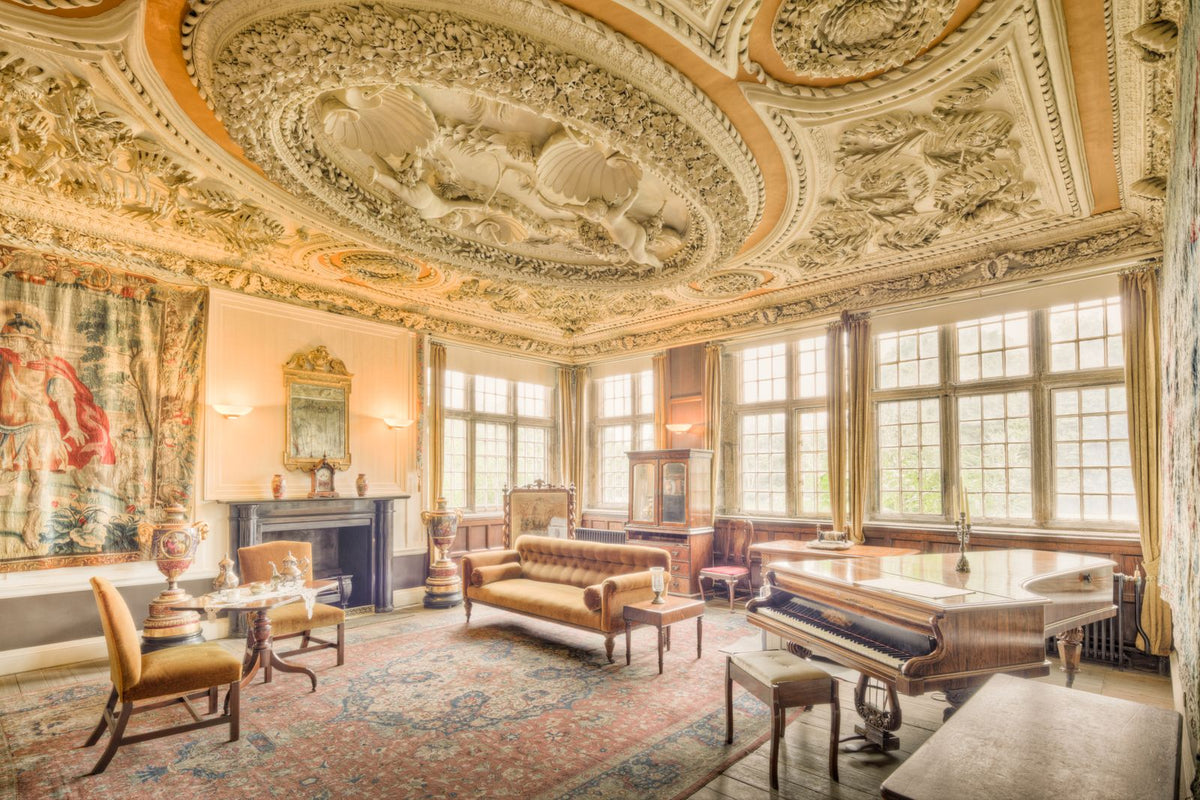
Short answer. Derbyshire country houses, manor houses and farmhouses were plastered in lime, so repairs should be made in lime too, and damaged cornice and ceiling roses can usually be repaired or matched to the original profile. Many of these homes are listed, so ask the council's conservation officer, or the Peak District National Park Authority if you are inside the park, before booking any work.
Would you rather have it done for you? Our own applicators provide cornice and coving installation across the UK, including Venetian plastering in Derbyshire.
Derbyshire is known for its great houses, such as Chatsworth, Hardwick Hall and Kedleston Hall. Alongside these famous names are many smaller manor houses, rectories, farmhouses and stone townhouses in places like Bakewell, Ashbourne and Wirksworth. Many are built in local gritstone or limestone, with thick solid walls and lime plaster inside.
Traditional lime plaster was often put on in three coats. The first, called the scratch coat, is scored so the next coat grips it. The second, the floating coat, builds the wall out flat. The last, the setting coat, is a thin, fine finish. Animal hair was often mixed into the base coats to hold them together.
When a patch fails, it is tempting to fill it with modern plaster. The problem is that modern plaster and lime behave differently. Modern plaster is harder and less porous, so moisture gets pushed to the edges of the patch, and the old plaster around it can start to break down. Repairing like with like, in lime, keeps the wall working as it always has. Our comparison of lime plaster and Venetian plaster explains how the two relate.
Cornice is the moulding that runs around the top of a wall where it meets the ceiling. In older houses it was often run on site. Wet plaster was built up and a running mould, a metal profile cut to the shape of the cornice, was pulled along it until the shape formed. Later work was often cast as fibrous plaster, which is plaster reinforced with hessian and timber, and fixed in sections.
Common problems include the following.
Matching usually starts by taking the exact profile from a surviving section, so new work follows the original line. Zavoré fits, matches and restores plaster cornice, coving and ceiling roses, and can finish the walls below in a breathable lime finish such as Marmorino or limewash.
Listed building consent can be needed for internal work, including plaster repairs and changes to mouldings. Ask the conservation officer at your local council before you book anything. Parts of Derbyshire sit within the Peak District National Park, where the National Park Authority deals with planning and listed building matters, so speak to them if your home is inside the park.
To see a wall finish in your colour, order a sample board, call 07592 929191 or email sales@zavore.co.uk. For our work in the region, see the Venetian plaster in Nottingham page.
In most cases a profile can be taken from a surviving section so that new lengths follow the original shape. The more of the original that survives, the easier the match.
Modern plaster is harder and less porous than lime, so it can push moisture into the old plaster around the patch. Repairing in lime keeps the wall behaving as one.
If your home is inside the Peak District National Park, the National Park Authority handles planning and listed building matters. Outside the park, ask your local council's conservation officer.
Three questions that help Nottingham and Derby homeowners choose between Venetian plaster, microcement and metallic finishes.
MarmorinoA guide to using Marmorino lime plaster in the Victorian and Edwardian homes of Nottingham, Derby and the surrounding towns.
Greater ManchesterHow Marmorino and microcement work on the plasterboard walls of new build apartment towers in Manchester and Salford, and how a job is pl...
BirminghamWhy microcement suits the converted warehouses and newer apartment blocks along Birmingham's canals, and what to check before work starts...
Coventry and WarwickshireAn in depth look at limewash for the cottages of Coventry and Warwickshire, from how it works to how to look after it.
Coventry and WarwickshireWhich polished plaster and stone effect finishes suit the different kinds of home found across Coventry and Warwickshire.

Providing luxury finishes for the most prestigious addresses in the world
Venetian plaster, limewash, microcement, tadelakt, metallics, sculptural plaster and gold leaf, supplied and installed by our own team, with Venetian plaster taught at our Birmingham studio.
One list, run by the people who make the material. No noise, and nothing we would not want to read ourselves.
We email as the house has something worth saying, never daily. Unsubscribe from any email, or reply STOP to any text. We never pass your details to anyone.