

✦
Where Artistry Begins
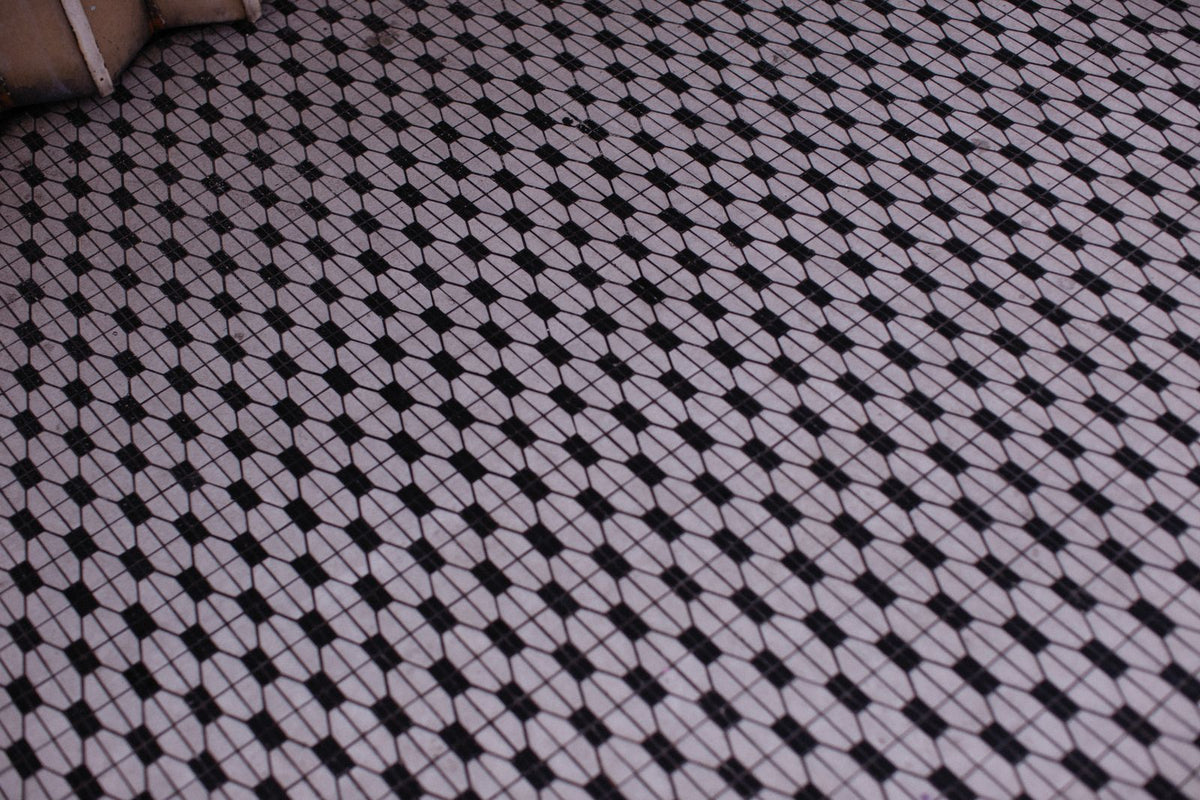
Victorian floor tiles are the patterned clay floors found in the halls, porches and front paths of so many British houses built in the second half of the nineteenth century. Many combine geometric tiles, plain tiles of one colour made in shapes, with encaustic tiles, where the pattern is inlaid in coloured clay. True mosaic is different again, made from many small pieces set together. An original floor can usually be cleaned and kept, as long as you treat it gently and call in a specialist for real damage. This guide covers the history, how to tell the types apart, how to care for an original floor, and how to create a new mosaic floor in a period style.

Inlaid floor tiles were made in England in the Middle Ages, and Historic England notes that tile pavements were popular in high status buildings until the sixteenth century. The Victorian revival began with a patent. In 1830 Samuel Wright of Staffordshire registered a method of pressing tiles using a plaster mould with the pattern carved into it, set in a metal frame and worked by a screw press.
Herbert Minton acquired rights to the patent and, according to Building Conservation, had the resources and tenacity to make the process a commercial success. Working with the architect Augustus Pugin, he was producing tiles in up to six colours by 1844, and his firm made around 75,000 tiles for the Palace of Westminster between 1847 and 1852. Minton remains the name most often found on the back of original encaustic tiles.
Chamberlain and Co of Worcester also took a share in Wright's patent, and its tile business passed to Maw and Co. The Ironbridge Gorge Museums record that Maw and Co was founded by George and Arthur Maw at Benthall, Broseley, in Shropshire, and grew into one of the world's largest decorative tile makers by the late nineteenth century. Its works dominated Jackfield, now home to the Jackfield Tile Museum.
Tiled floors became widespread from the 1860s and were a standard feature of new homes by the 1890s, laid in halls, porches, garden paths, churches and public buildings.

A quick test helps. If the pattern sits within a tile rather than across several, it is encaustic. If every tile is one colour, it is geometric.

Historic England advises that most old domestic floor tiles are robust enough for the low level of chemicals in ordinary cleaning products, but a little care goes a long way.
Never use beeswax or linseed oil as a protective coating, a warning given by both Historic England and the Tiles and Architectural Ceramics Society. The Society also warns that moisture absorbed into a tiled floor from below cannot escape if a covering does not allow it to evaporate. Building Conservation suggests that an acrylic sealer or polish is perhaps the best option today, because it is easy to apply and can be removed later. Ask a specialist before you seal anything.
Call one in if tiles are loose, lifting or tenting, if there are cracks running across the floor, if salts keep appearing, or if tiles are missing. Building Conservation estimates that around nine in ten damaged floors can be repaired, but any movement in the base has to be dealt with first. Historic England recommends a specialist conservator with professional accreditation, and if your home is listed, work may need listed building consent. Zavoré does not restore Victorian tiled floors, so for repairs we would always point you to a tile conservator.

If your hall has lost its original floor, or you want the same character in a kitchen, porch or bathroom, a new mosaic floor is one way to bring it back. Mosaic lets you echo Victorian layouts without copying them tile for tile.
Zavoré designs bespoke mosaics, including patterns, pictures and lettering, supplies ready made mosaics, and installs both, including mosaics you have bought elsewhere.
Geometric tiles are a single colour and the pattern comes from their shapes. Encaustic tiles have a pattern inlaid in coloured clay within each tile.
Not with beeswax or linseed oil. A removable acrylic sealer is one option, but it is best to take specialist advice first, especially if the floor shows signs of damp or salts.
No. We design, supply and install mosaic, but we do not restore original tiled floors. A specialist tile conservator is the right person for that.
Yes. We can design a bespoke mosaic with a border, a threshold panel or lettering, and install it across the UK.
Where to go next. See bespoke and ready made options on our mosaics page, read about the Roman mosaics that inspired so many later floors, or our guide to Victorian, Georgian and Edwardian coving. For ideas on finishing the walls above, see Venetian plaster for hallways and stairs, or contact us, call or WhatsApp 07592 929191, or email support@zavore.co.uk.
How Roman mosaics were made, from tesserae and layered lime setting beds to opus tessellatum and opus vermiculatum, with famous examples ...
CorniceA practical guide to painting coving and cornice, from preparation and filling cracks to choosing paint, cutting in and keeping ornate de...
CorniceWhere corbels come from in architecture, how corbels, brackets and consoles differ, where to use decorative plaster corbels, the main sty...
CorniceWhat dado rails and picture rails were originally for, where they usually sit on the wall, how they appear in Georgian, Victorian and Edw...
CorniceWall panelling ideas by style and by room, how to plan half height, full height and box panels, and an honest comparison of plaster panel...
GildingWhere urushi comes from, how traditional Chinese and Japanese lacquer is made and decorated with gold, how Europe imitated it with japann...

Authentic Venetian plaster, machine-tinted to your colour and made for each order. Materials, installation and master-led training, nationwide and international, since 2021.
One list, run by the people who make the material. No noise, and nothing we would not want to read ourselves.
We email as the house has something worth saying, never daily. Unsubscribe from any email, or reply STOP to any text. We never pass your details to anyone.