

✦
Where Artistry Begins
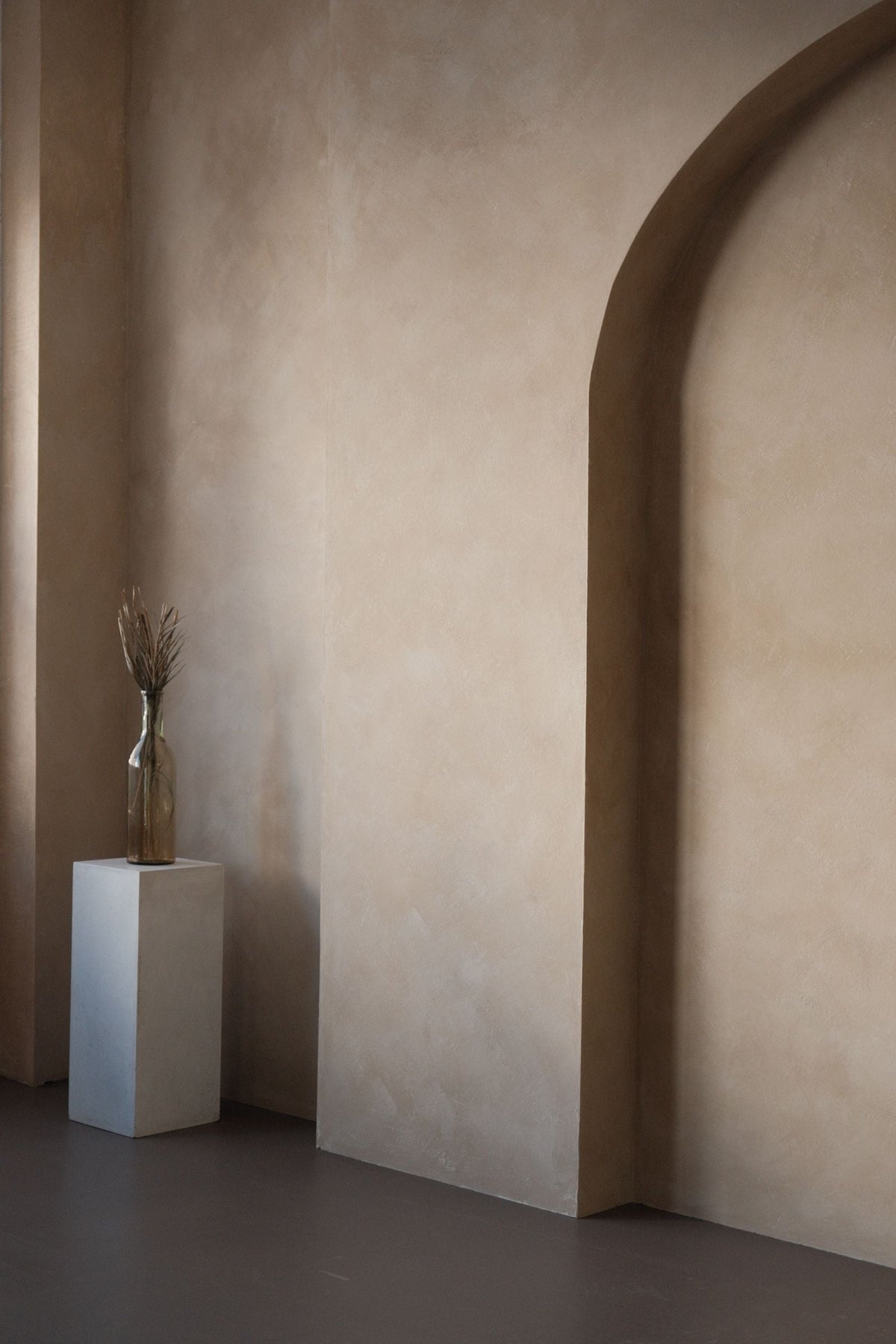
Yes, Venetian plastering is one of the most natural ways to finish a curved wall, an arch or a column. Zavoré installs lime based Venetian plaster, marmorino and polished plaster on curved surfaces across the UK with our own artisans. Because the plaster is laid by trowel in thin coats, it follows the shape with no joints or seams, so the curve reads as one continuous surface, provided the base underneath is smooth, sound and properly primed.
Our Venetian plaster installation page explains how a job runs from photographs to the final wax, and Venetian plastering across the UK lists the towns and cities we cover.
Most wall finishes are made flat and then forced around a shape. Tiles break the curve into facets, wallpaper has to be cut and joined, and timber or stone panels need specialist bending or carving. Plaster starts soft and goes on by hand, so it takes whatever form the wall already has. A rounded stair wall, a curved bay or a full column can be finished in one material from top to bottom.
That is also why curves have always been a home for decorative plaster, from domed ceilings and niches in period houses to the rounded corners of modern interiors. A lime finish has a gentle movement of tone that changes as you walk past a curve, which flat paint cannot give. Our Venetian plaster page describes the material and the finishes we lay.
Yes. Arches between rooms, arched alcoves and niches are some of the most rewarding places for a polished lime finish, because the inside of the arch catches the light differently from the face of the wall. Columns, whether structural or decorative, can be finished in Venetian plaster for a marble look. It is worth remembering that Venetian plaster gives a marble look but is not marble, so a column finished this way is far lighter than stone and has no visible joints.
Edges matter on arches and columns. The line where the curve meets a flat face needs to be crisp and even, and an arris on a column has to be protected as the coats build up. These details are planned at the survey.
Venetian plaster is not for inside showers, so a curved shower wall needs tadelakt or microcement on a waterproofed wall instead. The sealer makes microcement washable, but the wall behind a shower still needs tanking.
Preparation decides everything on a curve. A flat wall can hide a small dip, but on a curved one the reflection runs along the surface and any wobble in the line becomes obvious. At the survey we look at the base, check the line of the curve, and say plainly if it needs skimming or reshaping first.
Many modern curves are formed in flexible plasterboard. Those joints need reinforcing with tape and the right primer, so they do not show through the finish later. Solid masonry curves in older buildings usually suit a lime finish, because lime breathes and suits solid walls. Columns are checked for plumb and for any cracking where they meet the floor and ceiling.
Curved work often takes more care per square metre than flat work, which is one reason we do not give prices or timescales before the survey.
Not if they are prepared properly. Joints are reinforced and primed before the first coat, and the base is checked for an even line. Polished finishes show what lies beneath, so we treat this stage as part of the finish.
Yes. A polished Venetian plaster in a stone or marble colour gives a convincing marble look on a column, with no joints. It remains plaster, so it is lighter than stone and can be repaired locally if marked.
Both work. Marmorino is gentler on a tight arch or one with slight movement, while a polished Venetian plaster suits a wide, even arch where a deeper sheen is wanted. We suggest one at the survey.
Yes. Plaster materials are sold in our shop, tinted to your approved sample. Curves are demanding, so decorators often take a course at our Birmingham, London or Manchester centres first.
To talk about a curved wall, arch or column, call +44 7592 929191 (Monday to Saturday, 9am to 6pm) or email sales@zavore.co.uk with photos, rough measurements and the address. A sample board is a simple way to test colours on the curve itself.
Why limewash is a useful skill for builders and restoration trades who work on older buildings, and how to ask Zavoré about limewash trai...
LimewashHow limewash fits alongside Venetian plaster in a decorative finishing business, and how to ask Zavoré about limewash training.
InstallationHow to decide between buying Zavoré material supply only for your own decorator and having our applicators supply and install the finish.
AftercareA guide to the first weeks and months after a Zavoré installation, covering drying, gentle cleaning, fixings, small marks and when to get...
CommercialHow commercial decorative plaster installations are planned around opening hours and fit out programmes, and what to agree about site pap...
FlatsWhat to expect if you stay at home or in your flat while Zavoré installs a polished plaster, limewash or microcement finish.

Providing luxury finishes for the most prestigious addresses in the world
Venetian plaster, limewash, microcement, tadelakt, metallics, sculptural plaster and gold leaf, supplied and installed by our own team, with Venetian plaster taught at our Birmingham studio.
One list, run by the people who make the material. No noise, and nothing we would not want to read ourselves.
We email as the house has something worth saying, never daily. Unsubscribe from any email, or reply STOP to any text. We never pass your details to anyone.