

✦
Where Artistry Begins
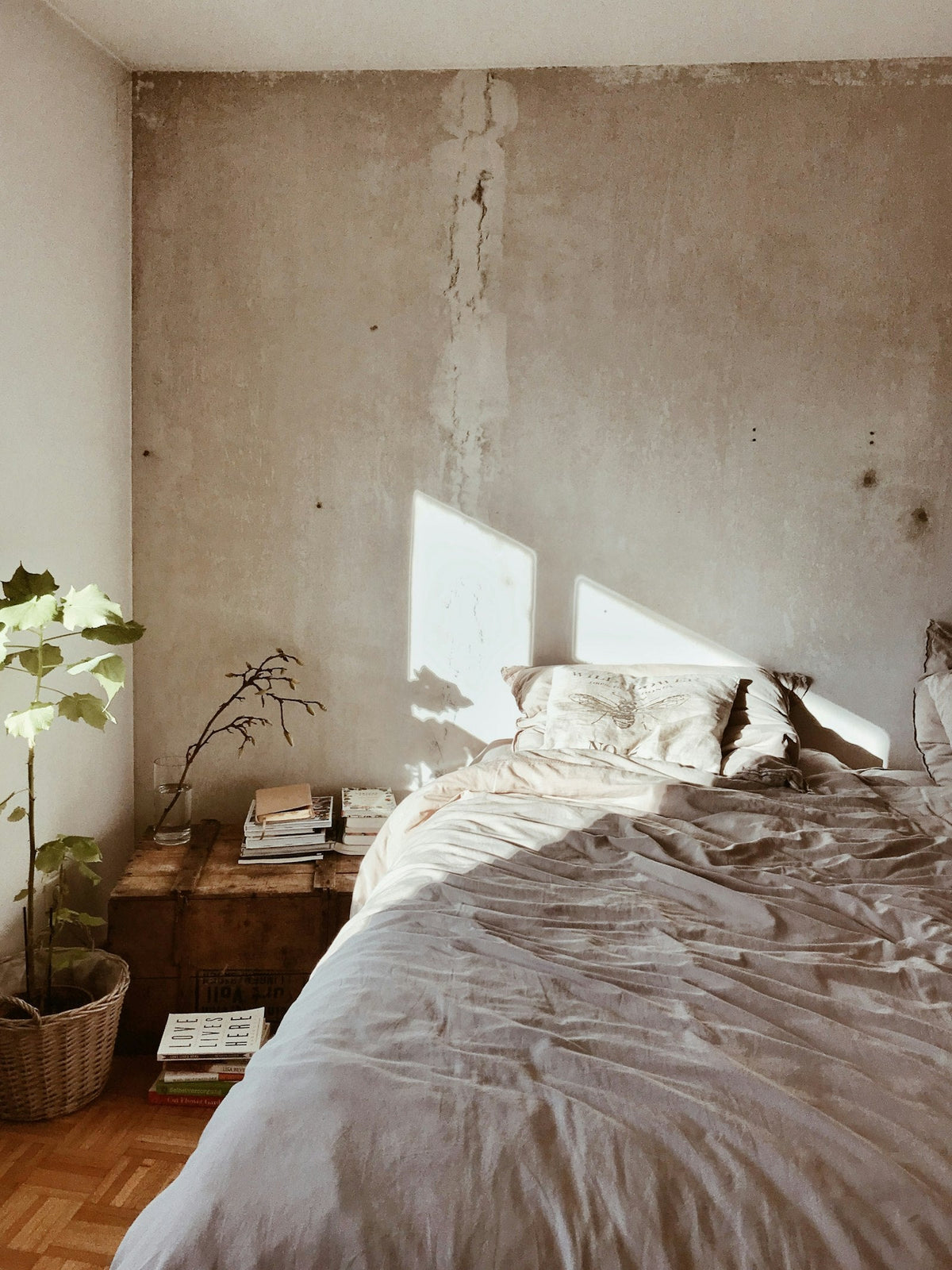
Venetian plaster in a bedroom should be matt or low sheen, not polished. A bedroom is a room you look at from a low angle, in soft light, often with a lamp close to the wall, and a high gloss finish in that situation throws reflections and shows every shadow on the surface. The finishes that work are the chalky, soft textured ones, Marmorino, Stucco Suede, Intonachino, limewash, usually on one wall behind the bed rather than all four. This guide covers which finish to choose, what sheen does in bedroom light, how to handle a headboard wall, colour, and how the surface behaves around dust and bedding.
If you want it installed, our own applicators handle Venetian plaster installation from survey to final coat.
Three things make a bedroom different from a hallway or a reception room.
First, the light is low and often to one side, from a bedside lamp or a half drawn curtain. Low side light at that angle exaggerates anything on a wall, so a mirror bright polish that looks superb in a dining room reads as glare from a pillow.
Second, you are usually lying down, and a polished wall reflects the ceiling light straight back at you when your eye level is a metre lower than usual.
Third, a bedroom is meant to be quiet. A matt lime surface absorbs light and softens the room; a gloss surface adds energy to it.
That does not mean no sheen at all. A low satin on a Marmorino still gives depth and still wipes clean. It means we stop the burnish well short of the high polish you would use on a stair core or a bar front.
Marmorino is the default. Laid in two coats over a primed wall and left with a matt to low sheen, it gives a dense, stone like surface with visible movement through it. It is calm at close range, it takes a soft colour beautifully, and it stands up to the occasional knock from a bed frame.
Stucco Suede at £200 is the one to reach for when the brief says soft. It leaves a very fine cloth like texture that catches light the way a fabric does, which is exactly right behind a bed. The metallic version, Stucco Suede Metallico at £175, adds a faint shift for a headboard wall that needs a little more presence without going shiny.
Intonachino at £200 is a fine aggregate finish. The texture breaks light up completely, so the wall gets its interest from surface rather than sheen. It is also the most forgiving over a wall that is not perfectly flat, which matters in older houses.
Limewash is the softest option of all: a mineral wash with cloud and movement, no polish, no plastic. It suits a period bedroom and it is the easiest of these to live with, though it is not wipeable in the way a sealed plaster is, so keep it away from the wall the children lean on.
| Marmorino | Stucco Suede | Intonachino | Limewash | |
|---|---|---|---|---|
| Sheen | Matt to satin | Soft, cloth like | Matt | Matt, chalky |
| Texture | Smooth, movement | Very fine | Fine aggregate | Flat with cloud |
| Hides a poor wall | Some | Some | Best | Good |
| Wipe clean | Yes, sealed | Yes, sealed | Partly | No |
| Feels | Stone | Fabric | Rendered, tactile | Old and quiet |
Nine bedrooms out of ten only need one plastered wall, and it is the one the bed sits against. That wall is what you see from the door, it frames the bed, and it is the only wall in the room with nothing else competing on it.
A few things we have learned about doing it well.
Our article on feature walls covers which wall to choose in a given room, and the room by room guide to Venetian plaster walls sets the bedroom against the rest of the house.
Bedrooms take deeper colour better than any other room, because you are not working in them and do not need the light.
Warm neutrals, greige, stone, clay, mushroom, are the most requested. They read calm at every time of day and they sit with timber and linen.
Deep colours work on a single wall. A dark olive, a deep plum brown or a charcoal behind the bed makes the room feel enclosed in a way a pale wall cannot, provided the rest of the room stays light.
Cool blue greys need care. They look sophisticated on a board and can read cold in a north facing bedroom in February.
Whatever the colour, judge it in the bedroom, dry, under the bedside lamps as well as in daylight. A sample board at £8 or the six board box at £35 is the only honest way to do it, and our colour guide explains why a screen or a printed chart will mislead you.
Bedrooms generate more dust than any other room, because bedding sheds fibre every time it is moved. On a textured finish that dust settles into the surface, and on a chalky one it can dull the colour over a long period.
The answer is not a heavier product, it is a protective coat and a soft cloth. A clear wax such as natural bees wax at £68, or a sealer at £25 where the wall needs to be wipeable, closes the surface so dust sits on top of it rather than in it. Then a dry microfibre cloth every few months is genuinely all it takes.
Marks come off with a damp cloth. Do not use abrasive cream or anything with bleach in it, because both take the sheen off and leave a dull patch that has to be reburnished. There is more detail in our guide to maintaining Venetian plaster.
One, in most cases. The wall the bed sits against. Four walls of lime plaster in a small bedroom removes the contrast that makes the finish look like a material, and it costs four times as much. The exception is a large bedroom with high ceilings and good light, where a soft matt finish wrapping the room can work beautifully.
Only if it is burnished to a gloss, which is a choice rather than a property of the material. Burnish level is set by how hard and how long the final coat is compressed, so the same product can leave a chalky matt wall or a mirror. For bedrooms we stop at matt or low satin.
A textured finish holds more dust than a smooth one, and bedrooms produce a lot of dust from bedding. Once the wall is waxed or sealed the dust sits on the surface rather than in it and comes off with a dry cloth. Unsealed, chalky finishes need more care and are better on a wall nobody touches.
Yes to both. Heat from a radiator is no problem for a lime plaster, though we would rather work with the radiator off the wall so the finish carries behind it cleanly. A bedroom chimney breast is one of the best places for the material, because the reveals and returns give the surface something to do.
Where to go next: look at the Marmorino and limewash pages to settle on a sheen, order a board from the shop and live with it beside the bed for a week, or see the installation page if you would rather we laid it ourselves.
How painting companies in Dubai can order Lime Paint for villa repaint work, with colours tinted room by room, labelled tubs and tracked ...
ContractorsHow plastering contractors can add microcement, tadelakt, limewash and Venetian plaster through Zavoré 1 to 1 Training, group courses of ...
Abu DhabiIf you searched for Venetian plaster paint for a villa in the UAE, here is what we actually supply, which real plaster to order instead a...
CoursesWhat three days on the Zavoré tadelakt course involve, from the base and radiused corners to the burnishing window, the stone, the soap a...
CoursesAn honest look at general plastering courses against the Zavoré Beginner Course in Venetian plaster at our Manchester centre, who each su...
Abu DhabiWhere Venetian plaster belongs in an Abu Dhabi villa bathroom, which finish takes over in the wet zone, and how the walls are sealed, sur...

Providing luxury finishes for the most prestigious addresses in the world
Venetian plaster, limewash, microcement, tadelakt, metallics, sculptural plaster and gold leaf, supplied and installed by our own team, with Venetian plaster taught at our Birmingham studio.
One list, run by the people who make the material. No noise, and nothing we would not want to read ourselves.
We email as the house has something worth saying, never daily. Unsubscribe from any email, or reply STOP to any text. We never pass your details to anyone.