

✦
Where Artistry Begins
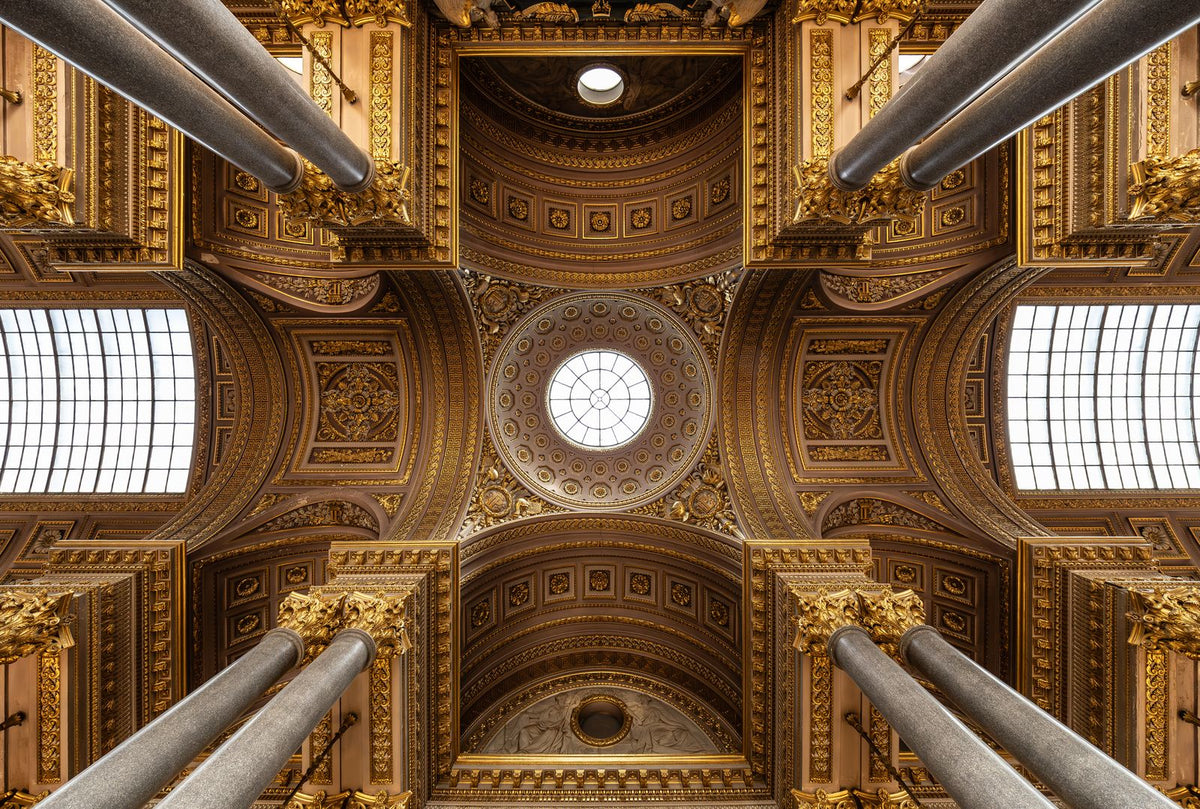
A gold leaf wall or ceiling is made by sealing the surface, brushing on a gold size and laying thin sheets of real or imitation metal leaf over it, each sheet slightly overlapping the last, then leaving the gold bare or sealing it according to the metal. For walls and ceilings, oil gilding is the usual method. Gold leaf holds and returns light, so a gilded ceiling, alcove or dome becomes the warmest, brightest surface in the room.
Below we look at some great gilded rooms, how the work is done in outline, which leaf suits a large area, and how gilding works with murals, cornice and lighting.

Built between 1678 and 1684, the Hall of Mirrors at the Palace of Versailles is 73 metres long. The Palace records that Charles Le Brun painted 30 compositions on its vaulted ceiling telling the story of Louis XIV's reign, while 357 mirrors line the arches opposite the windows. Its marble pilasters are topped with capitals of gilded bronze, and gold, painting and reflected light work together along the whole ceiling.
The Peacock Room began as the dining room of Frederick Leyland's London townhouse. In 1876 Leyland asked James McNeill Whistler to add some finishing touches, and the Smithsonian records that Whistler went much further, laying gold leaf on the shelves and in patterns on the walls. Leyland thought the gold garish. The room has been at the Smithsonian's National Museum of Asian Art in Washington since 1923.
At Spencer House in St James's, London, John Vardy's Palm Room has an arch formed by carved and gilded palm tree columns, with a domed apse beyond. Spencer House explains that the arch was borrowed from a design by John Webb for a royal bedchamber at Greenwich Palace. It shows gilding used to frame an alcove rather than cover a wall.
Designed by the royal decorator Frederick Crace, the Music Room at the Royal Pavilion has a domed ceiling which the museum describes as intricately gilded, set against hand painted red and gold canvases. It was damaged by fire in 1975 and again in the Great Storm of 1987, when a minaret crashed through the recently restored ceiling.
The method is the same as gilding a frame, on a far larger scale. Our guide on how to apply gold leaf covers the steps in detail.
Why oil rather than water gilding? Water gilding needs a ground of gesso built up in many coats, which suits frames and carving, while the same guidance notes that oil gilding can be applied with the right preparation to most building surfaces.
Genuine gold gives the deepest, warmest colour and, at high carats, will not tarnish. Silver leaf gives a cool, moonlit finish that suits pale schemes and painted backgrounds, but it tarnishes and must be sealed.
Imitation leaf, a brass alloy often called Dutch metal or schlag metal, is the practical answer for many large surfaces. One UK supplier sells it in sheets 140 millimetres square, about three times the area of a standard gold leaf, and lists it for gilding walls and ceilings. It must be lacquered, or it will tarnish over time. Our guide to gold, silver and copper leaf compares each metal in detail.
On a big scheme it can make sense to mix them, with real gold where the eye lands and imitation leaf across a broad ceiling.
Curved surfaces are where gilding is most rewarding. Light falls differently across every part of a dome or the back of an alcove, so the gold moves from bright to deep as you walk through the room.

Curves are also the hardest surfaces to gild. Flat sheets have to be cut and laid so they follow the shape without creasing, and working overhead makes judging the tack of the size harder still. An alcove, a niche or a small dome over a stair is often the best way to bring leaf into a home.
The great ceilings rarely use gold alone. It frames painted scenes and picks out the plasterwork around them.

We paint murals by hand on site, including chinoiserie painted directly onto gold leaf, silver leaf or grasscloth backgrounds, as well as florals, landscapes and scenes. A gold ground glows through every gap between the branches and birds, and murals in busy areas can be sealed. See our hand painted murals.
Gilding also brings plaster mouldings to life. Picking out the enrichments of a cornice, a ceiling rose, panel mouldings, columns or corbels in gold draws the eye to the detail. We supply, fit and restore plaster cornice and mouldings, so the plasterwork and the gilding can be planned together.

What you see in gold leaf is reflection, so lighting shapes a gilded wall or ceiling more than almost anything else.
It can be either. Genuine gold leaf is real gold beaten extremely thin. Imitation leaf is a brass alloy that looks similar when new but must be sealed to stop it tarnishing. We will always tell you which we propose.
Gold of 22 carat and above does not tarnish and is often left bare. Lower carat gold, silver, copper and imitation leaf all need sealing.
Building conservation guidance says unvarnished interior gilding should last almost indefinitely. Sealed imitation leaf depends on its protective coat being looked after.
Yes. We gild walls, ceilings, domes and alcoves by hand in gold, silver, copper and imitation leaf across the UK, including London, Birmingham and Manchester.
Where to go next. See our gilding service to find out how we work, read our guide to applying gold leaf, or explore murals on gold and silver leaf. When you are ready to talk about a gilded wall or ceiling, get in touch, email support@zavore.co.uk or call or WhatsApp 07592 929191.
Dining room feature wall ideas using lacquer, Venetian plaster, murals, chinoiserie, gilding and panel mouldings, with how dark dining ro...
Feature WallsWall mural ideas room by room, from bedrooms and living rooms to nurseries and garden walls, with the difference between hand painted and...
Feature WallsWave wall panels and organic sculptural plaster designs, curved walls, arches and niches finished in polished plaster and tadelakt, how t...
Feature WallsA guide to textured plaster walls, from marmorino, travertino, limewash and clay to concrete effect, sculptural plaster and relief, with ...
Bas ReliefClear definitions of bas relief, high relief and sunk relief, famous examples from the Parthenon to ancient Egypt, how relief is made in ...
Bas ReliefThe main kinds of sculptural wall art, from relief sculpted into the wall to sculptural plaster panels and hung pieces, with advice on ma...

Authentic Venetian plaster, machine-tinted to your colour and made for each order. Materials, installation and master-led training, nationwide and international, since 2021.
One list, run by the people who make the material. No noise, and nothing we would not want to read ourselves.
We email as the house has something worth saying, never daily. Unsubscribe from any email, or reply STOP to any text. We never pass your details to anyone.